Wood-fired sauna: how the stove heats the room and how to install it safely
A wood-fired sauna needs no wiring, just a stove, a chimney and dry wood. Here is how the stove turns a fire into soft heat, what the installation has to get right, and how to run it safely.
Short answer
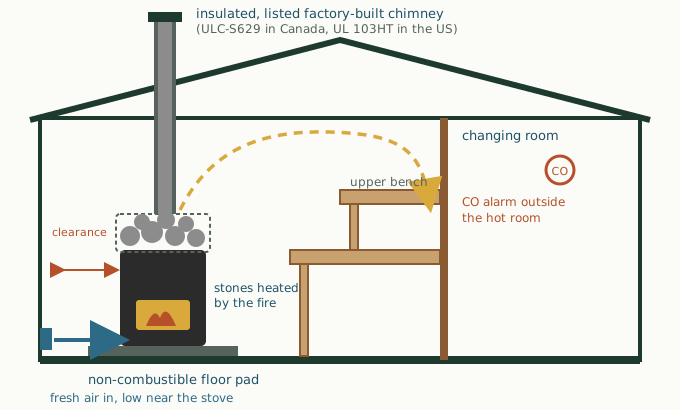
A wood-fired sauna is heated by a wood stove with a firebox below and a basket of stones on or around it. The fire heats the steel body and the stones, the hot surfaces warm the air by convection and radiation, and water thrown on the stones makes steam. A typical continuous-heating stove brings a small room up to bathing temperature in about an hour. A safe install follows the stove manual's clearances, sits on a non-combustible floor, vents through an insulated chimney listed to ULC-S629 in Canada or UL 103HT in the US, and burns only dry, seasoned firewood.
How a wood burning sauna heats up
Every wood sauna stove does the same three things. It burns wood in a closed firebox, it passes that heat into a mass of stones, and it lets the room take heat from both. The steel jacket and the flue pipe radiate heat straight at the walls and benches. Air touching the hot stove and stones rises, spreads across the ceiling and drops back down past the bathers, which is the convection loop you feel as the room warms. When you throw water on the stones, the stored heat turns it into a burst of steam, the löyly.
The stones are what make a sauna stove different from a cabin wood stove. Harvia's wood stove manual specifies stones 10 to 15 cm (4 to 6 in) across, of a dense type such as peridotite or olivine, and stacked loosely so air can move between them. The Finnish Sauna Society (Suomen Saunaseura) explains that in a continuously heated stove the stones are warmed partly by hot air moving through them and partly by conduction from stone to stone, so the gaps matter as much as the stones.
How long a wood-fired sauna takes to heat
For the common stove style, about an hour is a fair expectation. IKI's instructions put the heating time of its stoves at "approximately one hour," depending on the size of the room and the stove. HUUM's manual adds that heating time depends on the thermal resistance of the walls as well as room size and stove power, so a solid log or barrel sauna on a cold January night will take longer than an insulated room in July.
Heat-storing stoves, which hold a large mass of stones inside an insulated casing, are slower. Suomen Saunaseura describes them as needing a few hours to heat, and several hours for the larger stone loads. In exchange they give soft, even steam for a long evening without feeding the fire during bathing.
Once the room is warm, you're maintaining, not heating. Harvia's manual notes that a couple of pieces of wood are enough to hold bathing temperature, and warns that several full loads in a row can overheat the stove, the chimney and the room, which is a fire risk. It also says temperatures over 100°C (212°F) are generally too high for a sauna. The guide to sauna temperature covers what range to aim for.
Types of wood sauna stoves
| Stove type | How it works | Good for |
|---|---|---|
| Continuous heating, stones on top | Firebox below, an open stone basket or cage on top or around the body; fed during bathing as needed | Most cabin and backyard saunas; quickest to heat |
| Heat-storing | Large stone mass inside an insulated casing; heated before bathing, then the lid or hatch opens | Long sessions with soft steam; people willing to fire up hours ahead |
| Through-wall feed | Extended firebox passes through the wall so the door and loading are in the changing room | Keeping ash, wood and the person feeding the fire out of the hot room |
| Stove with water tank | A tank on the chimney or side of the stove warms washing water | Off-grid saunas without running hot water |
A through-wall stove needs extra care in the wall itself. HUUM's manual requires the firebox passage to go through a non-combustible wall such as stone or concrete, with mineral wool insulation and an air gap around the stove neck, and fire-resistant floor protection in front of the door if that floor is combustible.
A smoke sauna (savusauna), with no chimney at all, is a separate tradition and not something to improvise in a backyard.
Choosing a stove for your room
Stoves are rated by room volume, not floor area. Harvia's manual gives a volume range for each model in cubic metres, for example 6 to 13 m³ (about 210 to 460 cu ft) for its smallest model. Work out your room's inside volume and pick a stove whose range covers it comfortably. Harvia's own advice is that the most common mistake is choosing a stove too small for the room, and solid log or barrel walls, glass doors and cold outdoor sites all push you toward the upper end of a range.
Beyond size, decide on:
- Feed style: in-room door, or through-wall feed from the changing room.
- Stone capacity: more stones give gentler, longer steam but slower heat-up.
- Glass door or solid door: a glass door is pleasant to look at but some manuals need more front clearance for it. IKI lists 800 mm in front of a glass hatch against 500 mm for a solid one.
- Chimney exit: top or rear, which affects where the stove can sit and how the pipe passes through the roof or wall.
- Paperwork: ask whether the stove has North American testing or listing. Inspectors and insurers work from installation documents, so a stove with clear clearance tables is easier to approve.
To get a feel for the spread of options before narrowing down, a Canadian retailer's overview of wood-burning sauna stoves shows the range of sizes and feed styles side by side.
Installation essentials
Clearances to combustibles
Every manual has a clearance table. As examples: Harvia lists 1,200 mm (about 47 in) above and 250 mm (about 10 in) to the side for its smallest stove, and 500 mm on the sides, back and front for a larger one. HUUM gives 1,200 mm above its stove too. HUUM and IKI both allow the distance to wood walls to be reduced, by half with a single heat shield and to a quarter with a double one, if the shield is built as the manual describes. Benches count as combustibles, as do the wall panelling and the ceiling.
Floor protection
The stove must stand on something that won't burn. Harvia says a plain concrete floor at least 60 mm (about 2.4 in) thick needs no further protection as long as no wiring or water pipes run under it; tile or wood floors need a protective base. HUUM requires a non-combustible base at least 60 mm thick that extends 300 mm (12 in) past the sides and 400 mm (16 in) past the front of the stove. If your sauna has a wooden floor, the guide to the sauna floor covers the options.
The chimney
Sauna stoves run hot, and the chimney carries that heat through your roof. Use a factory-built, insulated chimney listed for solid fuel, and follow the chimney maker's own clearances.
- In Canada, the standard is CAN/ULC-S629, which covers factory-built chimneys for solid, liquid and gas-fired appliances with flue gases up to 650°C (about 1,200°F).
- In the US, the equivalent is a chimney listed to UL 103 Type HT. DuraVent's installation manual, for example, states its chimney is listed to UL 103 HT and was tested to 2,100°F (1,150°C) in three 30-minute runs, and certified to CAN/ULC-S629 for solid fuel in 6, 7 and 8 in sizes.
- European stove manuals refer to a T600 chimney class instead; in North America, the ULC or UL listing is what your inspector will look for.
- Don't share the flue with another appliance. Both Harvia and HUUM say the stove needs its own flue.
- Keep the required clearance where the chimney passes through the ceiling and roof, and use the listed ceiling support, firestop and roof flashing parts made for that chimney.
Fresh air
A wood stove burns room air, so the room needs a steady supply. In a gravity layout the inlet sits low and near the stove, and the outlet goes high on the far wall for drying the room after bathing. The full layout is in the guide to sauna ventilation.
WETT inspections in Canada
In Canada, wood-burning installations are commonly checked by a WETT-certified professional. WETT (Wood Energy Technology Transfer Inc.) describes itself as a non-profit training and education association that certifies individuals, not companies. Its inspections come in three levels: a visual Level 1 that covers most insurance and real estate needs, a technical Level 2, and an invasive Level 3 that may mean opening walls or chimneys.
WETT notes that each insurer sets its own rules on inspections, so call your insurer before you light the first fire. A sauna with a wood stove is a solid-fuel appliance on your property, and most policies want to know about it. In the US, the local building department and your insurer decide what inspection is needed.
Firewood: dry and seasoned
Wet wood is the most common cause of a smoky, slow sauna. Much of the fire's energy goes into boiling water out of the logs instead of heating the stones, and the fire burns cooler and smokier.
- The US EPA's Burn Wise program says wood burns best below 20 percent moisture, and recommends seasoning for at least six months and checking with a moisture meter.
- Natural Resources Canada's graded firewood bulletin puts ideal firewood at about 25 percent moisture, and notes that splitting speeds drying.
- Store wood off the ground with the top covered and the sides open to the air, as both EPA and NRCan recommend.
- Seasoned wood is darker, lighter and sounds hollow when two pieces are knocked together.
- Harvia's manual suggests splits of 8 to 12 cm (3 to 5 in) across to start the fire and 12 to 15 cm (5 to 6 in) to keep it going.
- Don't burn painted or treated wood, waste or coal in a sauna stove; Harvia's manual rules them out.
Use a meter on a freshly split face, not the outside of the log, for an honest reading.
Fire and carbon monoxide safety
Most of the safety work happens at install time. The rest is habit:
- Clean the chimney regularly. HUUM's manual calls for cleaning the chimney and flues at least once a year. How often depends on how much you burn; the guide on how often to clean a chimney goes through the signs.
- Don't overfire. Several full loads back to back can overheat the stove and chimney.
- Never cover the stove or hang towels near it. IKI's manual strictly prohibits covering a hot stove.
- Remember the stones, door and metal parts stay hot long after the fire dies down; IKI's manual warns about exactly that.
Off-grid and outdoor wood burning saunas
An off grid sauna is where a wood stove really earns its place. It needs no electrical service at all, so a sauna on a lake lot, a hunting camp or a back field can work as well as one next to the house. A stove with a water tank also gives you warm water for washing, and battery or solar lights cover the rest.
Compared with an electric heater, the practical differences are simple: a wood stove takes fuel, a chimney and more of your attention, while an electric heater needs a heavy circuit and a licensed electrician but runs on a timer. Which suits you mostly depends on whether there's power at the site.
For the outdoor build itself, an outdoor wood burning sauna follows the same rules as any wood-heated outbuilding: a non-combustible base under the stove, a listed chimney, and whatever setbacks and permits your municipality requires for a small accessory building.
Building a DIY wood fired sauna
If you're working from wood fired sauna plans or designing your own, settle the stove before you frame. The stove's clearance table decides where the benches go, how big the floor pad is, and where the chimney passes through the roof, and those are all much harder to move later. A sensible order:
- Choose the stove and download its installation manual.
- Lay out the room around the stove's clearances and the bench heights you want.
- Plan the non-combustible floor pad and any heat shields.
- Plan the chimney route, with listed parts from one maker.
- Place the fresh-air inlet and outlet.
- Check permit and inspection requirements with your municipality and insurer.
The wider project, from foundation to roof, is in the guide on how to build an outdoor sauna.
Questions people ask
How does a wood burning sauna work?
A wood fire in a closed firebox heats the stove body and a mass of stones. The hot surfaces warm the room by radiation and by convection, and water thrown on the stones makes steam. Smoke leaves through a chimney.
How long does a wood-fired sauna take to heat up?
With a continuous-heating stove, about an hour is typical; IKI gives approximately one hour for its stoves. Heat-storing stoves take a few hours. Cold weather and solid uninsulated walls slow things down.
What kind of chimney does a wood sauna stove need?
An insulated, factory-built chimney listed for solid fuel: CAN/ULC-S629 in Canada or UL 103HT in the US. It should serve the sauna stove only and be installed with the chimney maker's listed parts and clearances.
Do I need a WETT inspection for a sauna stove?
There's no single national rule, but many Canadian insurers ask for a WETT inspection of wood-burning appliances. WETT says each insurer sets its own requirements, so ask yours before you use the stove.
What moisture should sauna firewood be?
The US EPA says wood burns best below 20 percent moisture; Natural Resources Canada calls about 25 percent ideal. Season split wood for at least six months, covered on top, and check it with a moisture meter.
Where do I put a carbon monoxide alarm for a sauna?
Outside the hot room, never inside it. Read the alarm's manual for its temperature and distance limits, and put it in the changing room or the nearest heated space where people sleep.
Can I use a wood-fired sauna off grid?
Yes. A wood stove needs no electricity, which is why it is the usual choice at remote cabins. A stove with a water tank can also supply warm washing water.
Sources
- HUUM, HIVE Wood user manual (PDF)
- Suomen Saunaseura (Finnish Sauna Society), Sauna heater
- WETT Inc., About WETT inspections
- US EPA Burn Wise, Best wood-burning practices
- Natural Resources Canada, Solid Biofuels Bulletin No. 7, Graded firewood (PDF)
Written by Leah, who has spent the better part of two decades heating, fixing and occasionally rebuilding a lakeside sauna and the cabin next to it.
Keep reading
Backyard sauna ideas
Placement, paths, porches, cooling spots, privacy and styles for a sauna in the backyard or at the cabin.
Sauna floor
Sauna flooring compared: concrete, tile, stone and duckboards, with drains, waterproofing and insulation.
Diy sauna kits
Precut, panel, barrel and outdoor cabin sauna kits: what's included, assembly, heaters and a buying checklist.