How often to clean a chimney: the yearly inspection, the 1/8 inch rule and creosote
There is no fixed calendar for chimney cleaning. There is a yearly inspection, a thickness that tells you it's time, and a handful of habits that decide how fast you get there.
Short answer
Have a wood-burning chimney inspected at least once a year, which is what NFPA 211 requires, and clean it whenever soot or creosote reaches about 1/8 in (3 mm). For a modern certified stove burning dry wood, that usually works out to one cleaning a year, according to Natural Resources Canada. Older stoves, wet wood or slow, smouldering fires can build that much in weeks, so check the flue every couple of months during the heating season until you know your own rate.
The rule: inspect every year, clean by thickness
Chimney cleaning advice often gets boiled down to "once a year," which is close but not quite right. The standard behind it, NFPA 211, says chimneys, fireplaces and vents shall be inspected at least once a year for soundness, freedom from deposits and correct clearances. The Chimney Safety Institute of America (CSIA) follows that standard.
The inspection tells you whether to sweep. Cleaning is triggered by how much is in the flue:
- CSIA recommends sweeping masonry fireplaces at 1/8 in of sooty buildup, and sooner if any glaze is present. For factory-built fireplaces it says to sweep when any appreciable buildup occurs.
- Natural Resources Canada's A Guide to Residential Wood Heating gives the same mark for wood stoves: clean the chimney and flue pipes when deposits reach more than 4 mm (1/8 in).
- One common factory-built chimney manual treats a 3 mm (1/8 in) layer as significant and calls for cleaning at that point.
So the answer to how often you should clean your chimney is: as often as it takes to stay under that mark, and never less than an inspection a year. Some years that means one sweep. Some years, with a wet woodpile, it means two or three.
What chimney cleaning actually removes
Wood smoke carries unburned gases, water vapour and tiny tar droplets. When they hit a flue wall that is cool enough, they condense and stick. The result is called creosote, and NRCan describes it as highly flammable. Chimney cleaning (sweeping) is the mechanical removal of that layer, plus any soot, debris or nests, so the flue draws freely and has nothing in it that can catch fire.
Creosote doesn't look the same everywhere. Sweeps and CAA-Québec describe it in three degrees:
| Stage | What it looks like | How it comes off |
|---|---|---|
| 1st degree | Dusty, sooty, dry | A regular chimney brush removes it easily |
| 2nd degree | Flaky, crunchy | Brushing, sometimes with rotary tools; CSIA notes crusty creosote that fractures when hit can be removed with rotary cleaning |
| 3rd degree | Glazed, tar-like, may run or drip | CSIA says glazed creosote can't be removed by mechanical sweeping alone; it needs a professional and may need chemical treatment |
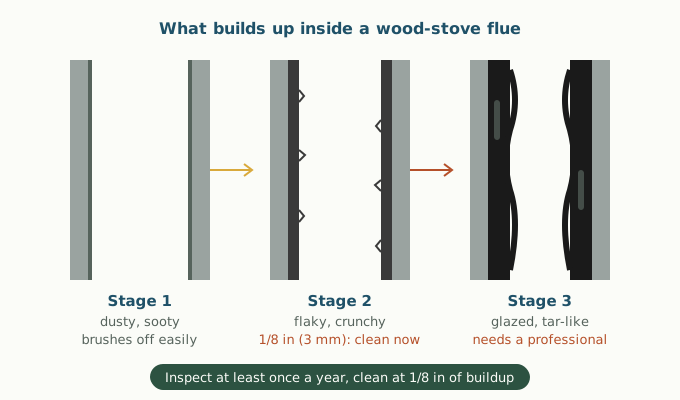
NRCan links the black, tarry type to smouldering fires. If you ever find glaze, the cleaning schedule is less important than the question of why the fire is running that cool.
How often by use pattern
None of the code bodies give a calendar by household, because the rate of buildup depends on the stove, the wood and how it is burned. The table below frames it the way they do: the inspection interval is fixed, and cleaning follows what the inspection finds.
| How the stove is used | Check the flue | Typical cleaning |
|---|---|---|
| Modern certified stove, dry wood, hot fires | Inspect yearly; check a few times in the first season to learn the rate | Often once a year (NRCan) |
| Main heat source all winter, several cords a season | Every couple of months in the heating season | Yearly plus a mid-season sweep; CAA-Québec suggests one after about three or four cords |
| Older uncertified stove, or fires often turned down to smoulder | Every few weeks | NRCan says such systems may need cleaning every few weeks |
| Seasonal cabin, weekends and holidays | Before the first fire each season, and yearly | When it reaches 1/8 in; cool start-ups add up faster than the cord count suggests |
| Wood-fired sauna stove | Yearly, and whenever draw gets sluggish | When it reaches 1/8 in; same rule as any wood flue |
| Little-used fireplace | Yearly anyway | As found; nests and debris are the usual problem |
The chimney manufacturer's manual may ask for more. One widely used factory-built chimney asks owners to inspect at least once every two months during the heating season, and warns that some appliances can create enough creosote in two weeks to cause a chimney fire.
What makes creosote build up faster
CSIA names three main accelerators: restricted air supply, unseasoned wood, and cooler than normal chimney temperatures. It also points to closing dampers or glass doors too early and overloading a wood stove's firebox. In practice, cabins and saunas tend to stack up several of these at once:
- Wet wood. NRCan puts properly seasoned firewood under 20% moisture; fresh-cut wood holds 35 to 50%. Every bit of that water has to boil off before the wood burns well, and it cools the flue while it does.
- Smouldering. Shutting the air down for a long, slow burn is the classic route to tarry deposits. An oversized stove encourages this, which is covered in choosing a wood stove for a small cabin.
- Cold flues. A chimney that runs up an outside wall, or a short system on a low cabin roof, stays cooler and condenses more.
- Seasonal use. A cabin that is cold through the week means every visit starts with a cold chimney and a long warm-up.
- Sauna stoves. A wood-fired sauna burns the same way a cabin stove does, and if the air is shut down early to hold heat in the room, it meets the same conditions CSIA lists: restricted air and a cooler flue.
Signs the chimney needs attention
Between inspections, a few things are worth noticing:
- The stove draws poorly or smoke spills into the room; NRCan ties low flue temperature and weak draft to smoke spillage.
- A look into the stovepipe or clean-out shows a layer approaching 1/8 in (3 mm), or anything glossy and tar-like.
- After the cabin was closed, birds or squirrels were seen around the cap, or twigs and debris show up in the stove.
Chimney fire: what it looks like and what to do
A fast chimney fire is hard to miss. CSIA and the Ontario fire service describe loud cracking and popping, a roar like a train or an aircraft, a lot of dense smoke, and an intense, hot smell, sometimes with flames visible at the chimney top. CSIA also warns about slow-burning chimney fires that don't get enough air to be dramatic. They can still reach very high temperatures, damage the flue and nearby framing, and are often only found at the next inspection.
Afterward, don't light the stove again until the chimney has been swept and evaluated by a qualified professional. CSIA suggests asking the sweep to photograph damage and creosote before cleaning, and to give a written repair estimate, both of which help with an insurance claim.
Cleaning a wood stove chimney yourself
Chimney cleaning is something a handy owner can do. CAA-Québec notes that pushing and pulling a chimney brush doesn't take special skills. What does take skill is judging what the brush uncovered, which is why the same source recommends having the full venting system inspected by a professional on a regular basis even if you sweep it yourself. A typical do-it-yourself sweep of a stove with a factory-built chimney goes like this:
- Let the stove and ashes go completely cold. Cover the floor around it and keep the stove door closed.
- Follow the chimney manual for access. Many cabin systems are swept from the top after removing the cap; others from below through a clean-out tee or by taking the connector pipe apart.
- Use a brush that matches the flue's size and shape, and the bristle type the chimney manual allows.
- Work the brush through the whole length in overlapping strokes, then do the connector pipe separately.
- Collect what falls down and remove it. CSIA notes that creosote left at the bottom of a chimney is a fire hazard of its own.
- Look at what you removed and at the flue itself. Glaze, cracked liners, damaged joints or a missing cap mean it's time to call a pro.
Hire a sweep when there is glazed creosote, a masonry chimney you can't see into, a recent chimney fire, an insurance requirement, or a roof you don't feel safe on. In Canada, look for a WETT-certified sweep; NRCan recommends one trained under the WETT program to clean the system top to bottom and report any problems. In the US, CSIA certification is the common credential, and CSIA suggests asking for a Level 1 inspection, as described in NFPA 211, along with the cleaning.
Do chimney cleaning logs work?
Creosote sweeping logs and powders are sold as a way to loosen deposits by burning a treated log. The industry bodies are cautious about them. CSIA has stated that only mechanical brushing with as complete a removal of creosote as possible is an adequate cleaning method, and it advises owners not to rely on logs, powders or liquids as their only maintenance. It does allow that some chemicals used under a professional sweep's direction can help with stubborn deposits. CAA-Québec is blunter: cleaning logs are no substitute for sweeping with a brush and can give a false sense of security.
If you use one, treat it as something done between sweeps, never instead of the yearly inspection.
After the closed season: animals, nests and caps
CSIA's reason for inspecting even little-used chimneys every year is simple: animals may build nests in the flue. A cabin chimney that sat cold from spring to fall is an inviting place for birds and squirrels, and a nest can block the flue completely. Before the first fire of the season:
- Look at the cap and screen from the ground with binoculars, or from the roof if it is safe.
- Shine a light up from the clean-out or stove collar and check for daylight or debris.
- Light a small test fire and watch that the smoke goes up and out promptly.
I prefer to book the inspection at the end of the season rather than the start, so any repair can happen over the summer. The guide to winterizing a cabin covers how to close up the stove and chimney when you leave.
Local codes and your chimney's manual can set stricter intervals than anything here, so check both, and follow the manual where it differs.
Questions people ask
How often should a chimney be cleaned?
Inspect it at least once a year, as NFPA 211 requires, and clean it whenever soot or creosote reaches about 1/8 in (3 mm). For a modern certified stove burning dry wood that is often once a year; older stoves or smouldering fires may need it every few weeks.
How often should you have your chimney cleaned if you only use it occasionally?
Still have it inspected every year. Light use builds less creosote, but CSIA points out that animals can nest in a little-used flue, and a blocked chimney is dangerous the first time you light the stove.
Do chimney cleaning logs work?
They are not a substitute for sweeping. CSIA says only mechanical brushing is an adequate way to remove creosote and advises against relying on logs, powders or liquids alone; CAA-Quebec warns they can give a false sense of security.
Can I clean my chimney myself?
Yes, for a straightforward stove chimney with light deposits, using a brush that fits the flue and following the chimney manual. Have a certified sweep (WETT in Canada, CSIA in the US) inspect the system regularly, and call one for glazed creosote or after a chimney fire.
What are the signs of a chimney fire?
Loud cracking and popping, a roaring sound, dense smoke and an intense hot smell, sometimes with flames or sparks from the top. Get everyone out and call 911, and don't use the stove again until the chimney has been inspected.
How do you clean creosote from a chimney?
Dusty and flaky creosote comes off with a chimney brush or rotary tools. Glazed, tar-like creosote can't be removed by brushing alone, according to CSIA, and needs a professional sweep.
Sources
- Chimney Safety Institute of America, FAQ (NFPA 211 inspection, 1/8 in rule)
- Chimney Safety Institute of America, Preventing chimney fires
- Chimney Safety Institute of America, What to do after a chimney fire
- Natural Resources Canada / CMHC, A Guide to Residential Wood Heating
- CAA-Quebec, Chimney cleaning: more than just a simple sweep
- Ontario Association of Fire Chiefs, chimney fire safety (Clarington Fire)
Written by Leah, who has spent the better part of two decades heating, fixing and occasionally rebuilding a lakeside sauna and the cabin next to it.
Keep reading
How to winterize a cabin
Closing a seasonal cabin for winter: water, well, toilets, stove, sauna and power, with a printable checklist.
Wood stove for a small cabin
Sizing a wood stove to a small cabin, certification, clearances, chimney, inspection and firewood.
What is a bunkie
The cottage sleeping cabin explained: sizes, Ontario permit thresholds, heat, insulation and build steps.