Sauna temperature: what is normal, how hot to go, and where to measure it
Most people ask how hot a sauna should be and get a single number back. The honest answer is a range, and it depends on the type of room, which bench you sit on and where the thermometer hangs.
Short answer
A traditional Finnish-style sauna usually runs at 80 to 100°C (176 to 212°F) measured at head height, with relative humidity around 10 to 20%, according to a 2018 review in Mayo Clinic Proceedings. Infrared rooms are much cooler, about 45 to 60°C (113 to 140°F), and steam rooms sit near 50°C (122°F) with the air fully saturated. Most home heater controls sold in North America top out at 194°F (90°C), and a comfortable starting point for many people is the low end of the range, then adjusting with steam and bench height.
What temperature should a sauna be?
There isn't one correct sauna temperature. There is a normal range for each kind of hot room, and then your own comfort inside it. For the traditional dry sauna, the figure most often quoted in medical writing comes from the review by Laukkanen, Laukkanen and Kunutsor in Mayo Clinic Proceedings (2018): the recommended temperature for a sauna bath is 80 to 100°C at the level of the bather's head, and it is lower at the floor. The same paper puts relative humidity in a typical Finnish sauna at 10 to 20%.
That range is a little higher than what many people actually use. The authors point out that the health data they reviewed comes from Finnish saunas with settings around 80°C, and that nobody knows yet whether cooler rooms give the same effects. The sensor maker Vaisala, writing up a 2023 field study by the Finnish group Saunalogia, describes a Finnish sauna as typically heated to between 60 and 100°C (140 to 212°F). The eight saunas measured in that study ranged from 74 to 120°C, read 30 cm below the ceiling.
| Type of room | Typical temperature | Relative humidity | Source |
|---|---|---|---|
| Traditional (Finnish) sauna, at head height | 80-100°C / 176-212°F | 10-20% (rises briefly with steam) | Mayo Clinic Proceedings review, 2018 |
| Finnish sauna, wider everyday range | 60-100°C / 140-212°F | varies with löyly | Vaisala, Saunalogia study write-up |
| Infrared sauna | 45-60°C / 113-140°F | low | Columbia University, Go Ask Alice |
| Steam room | about 50°C / 122°F | about 100% | Columbia University, Go Ask Alice |
| Typical North American heater control range | 40-90°C / 104-194°F | Harvia Xenio US manual |
So when someone asks for the average temperature in a sauna, a fair answer for a wood-lined Finnish room is somewhere around 80°C (176°F) at head height on the upper bench. A proper, normal sauna temperature is anything in the 70s to 90s Celsius (roughly 160 to 195°F) that lets you sit comfortably for several minutes and breathe easily. Hotter is not automatically better.
Temperature by bench height
Heat in a sauna stacks up in layers. The air right under the ceiling above the heater is the hottest spot in the room, and the floor is the coolest. The difference is large. The installation manual for Amerec's Designer series heaters shows a typical room running at about 190°F (88°C) at the ceiling above the heater and about 85°F (29°C) at the floor, and notes that air near the ceiling on the side opposite the heater is 15 to 25°F (8 to 14°C) cooler than right above it. The manual says ventilation reduces that variation but doesn't remove it.
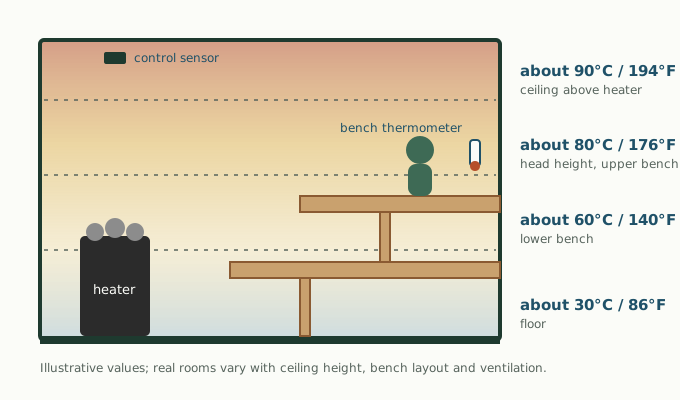
That layering is the whole reason saunas have two or three bench levels. In practice:
- the upper bench is where the stated room temperature applies, and where steam from the stones hits hardest;
- the lower bench is noticeably milder, which makes it the right seat for first-timers, older guests and anyone who feels light-headed;
- your feet on the floor sit in much cooler air than your head, so a foot rest or a higher upper bench keeps the difference between head and feet smaller.
If you want to change how hot the sauna feels without touching the thermostat, move down a bench. It is the quickest adjustment there is.
Humidity in a sauna, and what löyly does
A dry sauna feels dry because hot air can hold a lot of water before it gets anywhere near saturated. That is why the relative humidity reading on a sauna hygrometer looks tiny, often 10 to 20% even when the room feels heavy. Ladle water onto the hot stones and you get löyly, the Finnish word for the burst of steam and heat that rolls down from the ceiling. It raises the humidity for a minute or two and makes the same air temperature feel much hotter on your skin.
Finnish sauna researchers prefer to talk about absolute humidity (grams of water per kilogram of air) and the wet-bulb temperature, because relative humidity says so little at these temperatures. The Saunalogia study cites a 1969 recommendation by Professor Tuomo Tuomola of a wet-bulb temperature of 45 to 53°C, and treats 40 to 70 grams of water per kilogram of air as a suitable range. Seven of the eight saunas they measured reached at least 40 g/kg once water was thrown on the stove.
What this means at home:
- A hotter, drier room (say 90°C with little steam) and a slightly cooler room with regular löyly (say 75°C) can feel equally intense. Many people find the second more pleasant.
- Dry sauna temperatures often get pushed higher than they need to be because the room feels flat without steam. Try lowering the setting a few degrees and using water instead.
- Throw small amounts. Amerec's manual suggests one dipper, about half a cup, at a time, and keeping clear of the steam as it rises off the stones, because it can scald.
Traditional, infrared and steam room temperatures
These three rooms get lumped together, but they heat you in different ways, so the numbers aren't comparable.
| Traditional sauna | Infrared sauna | Steam room | |
|---|---|---|---|
| How it heats you | Hot air and stone heat, plus steam from löyly | Infrared emitters warm the body directly; the air stays cooler | Saturated hot steam |
| Air temperature | about 80-100°C / 176-212°F at head height | about 45-60°C / 113-140°F | about 50°C / 122°F |
| Humidity | Low, with short bursts from water on the stones | Low | About 100% |
| Feels like | Dry heat that changes with every ladle | Gentle warm air, heat felt on the skin | Wet, heavy, foggy |
An infrared cabin set to 55°C is running normally; a Finnish sauna at 55°C will feel like it hasn't finished heating. If you are judging a room by its thermometer, compare it only with its own type.
How hot can a home sauna get?
If you've bought an electric heater in Canada or the US and wondered why the dial stops short of 100°C, you're not imagining it. Harvia's North American Xenio controller manual lists a setting range of 104 to 194°F (40 to 90°C), and Amerec's heater manual says the hottest point in the room, the ceiling above the heater, should not exceed 194°F (90°C). The 194°F figure is often attributed to UL listing requirements for sauna heaters. I couldn't read the standard itself to confirm that, so treat it as the common North American cap rather than a law of physics.
Two things are worth knowing about that cap:
- The 194°F is what the sensor near the ceiling reads, not what you sit in. Your head on the upper bench is usually a bit cooler.
- Wood-fired stoves have no thermostat at all. A well-fed wood-fired sauna can run hotter than an electric one, which is part of the appeal and also a reason to keep an honest thermometer on the wall.
Sauna temperature converter
Type a reading in either box, or tap a common setting. The third box shows where it sits against the 80 to 100°C head-height range from the Mayo Clinic Proceedings review.
How long to stay in a sauna
Time matters as much as temperature. The Mayo Clinic Proceedings review describes a typical sauna session as 5 to 20 minutes, sometimes longer depending on the person, with Finns bathing on average two to three times a week. During a session heart rate can climb to 120 to 150 beats per minute, so the heat is real work for your heart even while you sit still.
Amerec's heater manual lays out a simple pattern for home use: 10 to 15 minutes in the heat, 10 to 15 minutes resting outside, repeated two or three times, finishing with a cool rinse. That's a sensible template, not a rule. A few practical points:
- Leave when you feel like leaving. Dizziness, a pounding head or nausea mean get out now, not after the timer.
- Drink water before and after. You lose more sweat than you'd guess.
- Stand up slowly. Blood pressure tends to drop in the heat and getting up fast off the top bench is when people feel faint.
- Cooling off between rounds can be a shower, sitting outside, or a lake dip. If you're curious about the cold side, see the guide to sauna and cold plunge routines, including the safety part.
Who should be careful with sauna heat
- Alcohol. The same review links sauna bathing combined with alcohol to low blood pressure, heart rhythm problems, falls and burns, and says sudden deaths in saunas have been at least partly due to drinking. Amerec's manual warns that alcohol, drugs or medication can greatly increase the risk of fatal overheating. Save the beer for after.
- Pregnancy. Ireland's Health Service Executive advises pregnant women to avoid saunas and hot tubs, because overheating in pregnancy can raise the risk of premature birth and certain birth defects. Heater manuals say the same in shorter form: consult a physician first.
- Children and older guests. Put them on the lowest bench, keep sessions short and stay with them.
- Anyone unwell. Skip the sauna with a fever or a stomach bug.
Where to put a sauna thermometer
Most arguments about how hot a sauna "really" is come down to where the thermometer hangs. The control sensor of an electric heater is meant to sit in the hottest part of the room so it can protect the wood and the heater. Harvia's Xenio manual puts the sensor on the wall or ceiling above the heater, 100 mm (about 4 in) from the ceiling, and at least 1000 mm (about 3 ft 3 in) from any air vent. Amerec specifies about 5 in from the ceiling directly above the heater. So the control panel shows the top of the heat layer, not the bench.
For a reading that matches what you feel:
- Hang a separate sauna thermometer (a combined thermometer and hygrometer is handy) on the wall at about head height of someone seated on the upper bench.
- Keep it out of the plume directly above the heater and away from the door, where cool air sneaks in.
- Keep it clear of the fresh air inlet. A vent blowing on it will read low, which is also why the sauna ventilation guide keeps supply air away from the heater's sensor.
- Expect it to read lower than the control panel. How much lower depends on ceiling height, bench height and ventilation, so learn your own room rather than chasing the display.
In a wood-fired sauna the bench thermometer is your only control, so it's worth buying a decent one rated for sauna heat and leaving it in the same spot, so readings stay comparable from one evening to the next.
Questions people ask
What is a normal sauna temperature?
For a traditional Finnish-style sauna, 80 to 100°C (176 to 212°F) measured at head height is the range given in a 2018 Mayo Clinic Proceedings review. Many home saunas run a little cooler, around 70 to 90°C (158 to 194°F), and that is still normal.
What temperature should a sauna be for beginners?
Start at the lower end, around 70 to 80°C (158 to 176°F), sit on the lower bench and keep the first sessions short. You can raise the heat or move up a bench once you know how your body reacts.
Why does my sauna only go to 194°F?
Most electric heater controls sold in North America are limited to 194°F (90°C), and manuals such as Amerec's say the ceiling above the heater should not exceed that. The sensor sits near the ceiling, so the benches are usually cooler than the display.
What humidity should a sauna have?
A dry sauna typically shows 10 to 20% relative humidity, rising briefly when water is thrown on the stones. Finnish researchers prefer absolute humidity and cite about 40 to 70 grams of water per kilogram of air as a comfortable range during löyly.
Is an infrared sauna as hot as a regular sauna?
No. Infrared saunas usually run around 45 to 60°C (113 to 140°F) because the emitters warm your body directly, while a traditional sauna runs around 80 to 100°C at head height.
How long should you stay in a sauna?
Sessions of 5 to 20 minutes are typical, often repeated two or three times with rest in between. Leave sooner if you feel dizzy or unwell, and check with your doctor if you have a heart condition or are pregnant.
Sources
- Laukkanen JA, Laukkanen T, Kunutsor SK. Cardiovascular and other health benefits of sauna bathing: a review of the evidence. Mayo Clinic Proceedings, 2018
- Vaisala, Can you handle heat and humidity? Finnish sauna study with Saunalogia
- Columbia University, Go Ask Alice: What's the difference between a steam room and a sauna?
- Health Service Executive (Ireland), Recommended exercises in pregnancy
Written by Leah, who has spent the better part of two decades heating, fixing and occasionally rebuilding a lakeside sauna and the cabin next to it.
Keep reading
Wood-fired sauna
How wood sauna stoves heat the room, stove types, chimney and clearance basics, firewood and CO safety.
Backyard sauna ideas
Placement, paths, porches, cooling spots, privacy and styles for a sauna in the backyard or at the cabin.
Sauna floor
Sauna flooring compared: concrete, tile, stone and duckboards, with drains, waterproofing and insulation.