Barrel sauna: how it works, pros and cons, and whether it's worth it
A barrel sauna is the backyard sauna most people picture first: a wooden tube on two cradles with a door at one end. Here is how the shape behaves, what it asks of you in upkeep, and when a square cabin is the better buy.
Short answer
A barrel sauna is a round outdoor sauna made of thick wooden staves held together by metal bands and set on two cradles. The round shell has less air to heat than a square room of the same width and no cold corners, so it warms up efficiently with a modest heater. The trade-offs are less headroom, a single uninsulated wall, and some upkeep: the bands need retightening as the wood swells and shrinks, and the shell needs a proper roof covering. For one to six people who want a simple backyard sauna, a barrel is worth it; for tall bathers, tiered benches or year-round heavy use in a cold climate, a cabin-style sauna is often the better choice.
What a barrel sauna is
Strip away the marketing and a barrel sauna is a short wooden tube with a wall at each end. The curved shell is made of long boards called staves, milled with a tongue and groove or a shaped edge so they lock together side by side. Metal bands wrap the outside and pull the staves tight, the way hoops hold a wine cask. The end walls are flat panels, one with the door (often a glass door or a full glass panoramic end), and the whole thing rests on a pair of curved wooden cradles.
Most wooden barrel saunas are sold as DIY sauna kits: precut staves, end walls, benches, bands, cradles and a heater package. Assembly is mostly stacking staves into the cradles and tightening bands, which is a large part of the appeal. There's no framing, no vapour barrier, no insulation and no interior panelling to install, because the stave is the wall, the insulation and the finish all at once.
Why the round shape heats well
The first advantage is geometry. A circle fills about 78 percent of the square drawn around it, so a barrel 7 ft (2.1 m) across holds roughly a fifth less air than a square room 7 ft wide, 7 ft tall and the same length. Less air means less to heat, and a smaller heater does the job.
The second is the lack of corners. In a box-shaped room, hot air rises and spreads along a flat ceiling, and corners tend to stay cooler. In a barrel, air rising off the heater meets a curved ceiling and slides down the walls on both sides, back toward the benches. Manufacturers lean on this point heavily; Almost Heaven, for example, describes heat that "gets circulated back down along the curved walls instead of pooling near the top." That is a seller's claim, but the physics is reasonable, and it matches what most barrel owners notice: the room comes up to temperature quickly and the heat feels even across the bench.
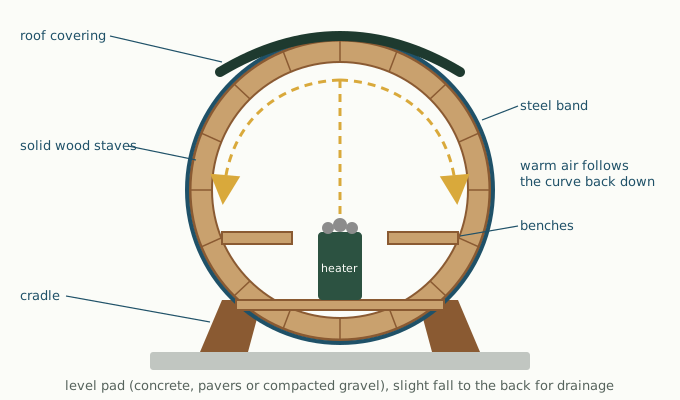
The same shape has a cost. The widest, tallest point is in the middle, so headroom drops off quickly toward the walls, and the benches have to sit fairly low. If you're tall, or you like a high top bench where the heat is best, sit in a barrel before you buy one.
Staves, bands and seasonal movement
Solid wood takes on and gives off moisture with the weather, and it swells and shrinks as it does. In a framed sauna that movement is hidden behind the panelling. In a barrel it's the whole structure, and the bands are what keep it closed.
Kit manuals are consistent on this. SaunaFin's barrel instructions say to tighten the bands as tight as possible during assembly and warn that "you may need to tighten the bands after a period of time, usually within the first few months," because depending on humidity the cedar "will either shrink or expand." The goal is for the wood to swell into the bands and seal the joints. Palmako's barrel manual puts it more bluntly: tighten the bands so there is no visible gap between the staves, and check and retighten regularly. Dundalk Leisurecraft lists band tightening as normal owner maintenance, outside the warranty.
In practice that means:
- Expect to retighten in the first season, when the new wood settles in.
- Check the bands again each spring and fall. Dry winter air shrinks the staves; a humid summer swells them.
- Don't assemble a kit with wet staves. SaunaFin's manual says to let the wood dry first, or the joints open up later.
- Follow your own kit's instructions on torque and band spacing. Bands are stainless steel on some kits and marine-grade aluminum on others, and the hardware differs.
Aleko's barrel manual notes that water may seep between staves because softwood is porous and says it dries quickly once the heater is on. A proper roof covering is what stops it from becoming a habit.
Which wood barrel saunas use
Most cedar barrel saunas sold in Canada and the US use western red cedar or eastern white cedar. The Canadian Wood Council describes western red cedar as highly resistant to decay and dimensionally stable, and names sauna panelling as a typical use. It also notes the wood is fairly lightweight, which makes long staves easier to handle during assembly.
European kits are often Nordic spruce or pine, and a growing number use thermally modified (thermo) wood, which has been heated in a kiln to change how it takes up water. A 2024 study in BioResources by Masoumi and Bond found thermal modification significantly cut water absorption and improved dimensional stability in the woods they tested, which is exactly what you want in a stave that lives outdoors. Untreated spruce is fine too, but it moves more and will show pitch pockets; Palmako's manual notes that these "can always appear in spruce wood."
| Wood | Where you'll see it | What it's like in a barrel |
|---|---|---|
| Western red cedar | Premium North American kits | Decay-resistant, stable, aromatic, light; the usual first choice for an outdoor barrel |
| Eastern white cedar | Canadian-made kits | Used in Canadian-made barrel lines such as Leisurecraft's; another naturally durable cedar |
| Thermo spruce or pine | Many European kits | Heat-treated to take up less water, so it moves less than untreated softwood |
| Untreated spruce or pine | Lower-cost kits | Works, but moves more with the seasons and needs a good roof sooner |
There's more on species in the guide to the best wood for a sauna.
Roof options and Canadian winters
A bare barrel is a row of horizontal joints facing the sky. Rain and snowmelt sit on top, work into the joints and soak the upper staves, which is where barrels rot first. A roof covering fixes that, and outside a dry climate it isn't optional.
The usual options in kit manuals:
- Asphalt shingles over an ice and water shield, laid on triangular supports along the top (Leisurecraft's optional roof).
- An EPDM rubber membrane with cedar bevel siding stapled over it (SaunaFin's cedar roof kit).
- Bitumen roofing felt or shingle tiles, common on European kits; Aleko's manual also says shingles or other roofing can be added over the top section for extra protection.
In Canada and the northern states the roof also has to deal with snow and freeze-thaw. None of the kit manuals I read give a snow-load rating, so treat the barrel as a small outbuilding: brush heavy snow off the top, keep the snowbank away from the end walls, and don't let meltwater pond against the bottom staves. Palmako's instructions also say to pay attention to the prevailing wind direction when you place the sauna, which matters for both drifting snow and the door.
Foundation: level cradles on a pad
A barrel doesn't need a full foundation, but it does need a level, solid base under both cradles. If the cradles sit out of plane, the barrel twists, the door binds and joints open on one side.
The kit manuals agree on the basics. SaunaFin and Leisurecraft both say the base should be level with a slight slope to the back for drainage, and list a concrete pad, a wood deck, compacted crushed stone or patio pavers as acceptable bases. Aleko's manual says to check the deck is level and to shim if it isn't. SaunaFin's chart sizes the pad from about 48 x 60 in for a 6 ft barrel to 60 x 84 in for a 7 x 8 ft model, and suggests building it larger so you have somewhere to sit and cool off.
Whatever the base, drainage is the part to get right in frost country: water that collects under the cradles freezes, heaves and throws the barrel out of level. If you're building a deck for it, check the cradle load points line up with joists. The guides on how to build an outdoor sauna go further into pads and footings. Permit rules for small accessory buildings vary by municipality, so check with yours before pouring anything.
Barrel sauna sizes by number of people
Barrels are sold by diameter and length. The diameter is usually around 6 to 7.5 ft (1.8 to 2.3 m) and doesn't change much across a range; the length is what changes the seat count. A 2 person barrel sauna is often around 4 to 5 ft long, while a 6 person barrel sauna runs closer to 10 ft. Some longer models add a small changing room or porch inside the same shell.
| Seats | Typical length (approx.) | Notes |
|---|---|---|
| 2 people | 4-5 ft / 1.2-1.5 m | One bench each side or a single bench across the back; quickest to heat |
| 4 people | 6-7 ft / 1.8-2.1 m | The most common backyard size; two people per side |
| 5-6 people | 8-10 ft / 2.4-3.0 m | Room to stretch out; often offered with a porch or changing room |
| 6-8 people | 10 ft and up / 3.0 m+ | Bigger heater needed; check the base and site access |
Dundalk Leisurecraft's Canadian Timber line, for example, lists about 6.6 ft for 4 people, 7.9 ft for 5 and 9.8 ft for 6 (outside lengths), all with the same 7.2 ft outside diameter. Seat counts are for people sitting upright and close together; for a relaxed session, knock one person off the label.
A panoramic barrel sauna replaces the back wall with a large glass panel. It's lovely facing a lake or woods, but glass loses heat faster than solid wood, which brings us to heater sizing.
Heaters: wood-burning or electric
Both work in a barrel. A barrel sauna wood burning stove gives you the crackle, the soft steam and freedom from wiring, and it's the usual choice at a cabin with no big electrical service. It needs a chimney through the shell, clearances to the staves, a heat shield and dry firewood; the details are in the guide to the wood-fired sauna. An electric heater is simpler day to day: a timer, a thermostat, no ash. Leisurecraft's manual says wiring must follow the heater maker's instructions and be done by a licensed electrician.
Size the heater to the room, not to the label on the box. Heater manuals size by volume in cubic metres, and they adjust for walls that soak up heat. Harvia's installation manual says to add 1.2 m³ to the room volume for every square metre of glass or other uninsulated surface, and to multiply the volume of a log-walled sauna by 1.5 because solid log walls warm slowly. A barrel's solid staves behave much more like log walls than like an insulated framed room, which is why kit makers often pair even a compact barrel with a heater that looks generous for its size. Leisurecraft, for instance, recommends 6 kW for its 4 and 5 person barrels and 7.5 to 9 kW for the 6 person model.
In Canada, dealers such as harviaheater.ca list heaters sized for small rooms like these, which makes it easier to compare outputs against the volume you work out below.
Barrel volume and heater sizing estimate
Enter the inside diameter and length, plus any glass area. The adjusted figure applies Harvia's 1.5 multiplier for solid walls and adds 1.2 m³ per m² of glass. Compare it with the room-volume range in your heater's manual.
The calculator treats the barrel as a full cylinder, so it errs slightly high, the safe direction for a cold site.
Barrel sauna ventilation
Barrels are small and tight, so fresh air matters more than people expect. Many kits ship with a single small vent and little guidance. Leisurecraft's wood-stove setup, for example, uses a 2 in (51 mm) hole with a cover outside and an adjustable vent board inside. SaunaFin's manual puts the inlet low below the heater and the outlet high in the far corner.
The working rule from heater manuals is about six air changes per hour, with the inlet low near the heater and the outlet on the far side of the room. In small barrels the gap under the door and the slatted benches are part of the airflow path, so don't seal them. The full layout for electric heaters and wood stoves is in the guide to sauna ventilation.
After the last round, leave the door open for a few hours so the wood can dry, as Leisurecraft's manual advises. If the sauna sits unused for a long stretch, Palmako recommends heating it about once a month to keep mould away.
Barrel sauna pros and cons
| Pros | Cons |
|---|---|
| Less air to heat than a square room of the same width, so a smaller heater works | Headroom falls away toward the walls; tall bathers notice |
| No corners, and heat rolls back down the curved walls | Benches sit low, so feet can run cooler than heads |
| Kit assembly with basic tools, no framing or insulation | Single solid wall with no insulation; loses more heat on very cold nights |
| Sits on cradles on a simple pad, no full foundation | Bands need retightening as the wood moves with the seasons |
| Small footprint for the seat count | Needs a roof covering, or the top staves soak and leak |
| Looks good in a backyard, especially with a glass end | Hard to fit a second tier of benches or a separate changing room |
Barrel vs cabin-style sauna
A cabin sauna is a small square or rectangular building: framed or log walls, a pitched or flat roof, often a changing room. SaunaFin's comparison sums it up fairly: barrels need a smaller footprint because of their rounded edges, but they're shorter inside, while cabins offer more overhead space and more flexible seating.
| Barrel sauna | Cabin-style sauna | |
|---|---|---|
| Air volume for the footprint | Lower, so it warms faster with a smaller heater | Higher; corners and flat ceiling to heat |
| Headroom and benches | Limited; usually one bench level per side | Room for a high upper bench and tiered seating |
| Walls | Solid staves, no insulation | Solid logs, or framed and insulated with panelling |
| Changing room | Only in longer models, and small | Easy to add |
| Assembly | Kit on cradles, quick | More work; framed builds need insulation and a vapour barrier |
| Base | Level pad under two cradles | Pad, piers or a proper foundation depending on size |
| Ongoing upkeep | Band checks, roof covering, stave joints | Roof and exterior finish like any shed |
| Best for | Two to six people, quick sessions, smaller yards | Tall bathers, families, hot top-bench sessions, year-round use |
If you're weighing up other layouts too, there are more options in the collection of backyard sauna ideas.
Is a barrel sauna worth it?
For most backyards, yes, with eyes open. A wooden barrel sauna is the fastest route from an empty corner of the lawn to a working hot room. It heats well, assembles from a kit, and doesn't need a foundation crew. What you sign up for is a little seasonal fuss: tightening bands, keeping the roof sound, and accepting a lower ceiling than a purpose-built cabin.
It's a weaker fit if you're tall, want a high top bench, plan daily use through a hard winter, or need a family-sized changing room. Then a small insulated cabin usually pays off.
If you're wondering how to build a barrel sauna yourself, sauna barrel kits are the practical route: the staves arrive milled to a matching edge profile, and your share of the work is the level base, the band tightening, the roof covering and the heater and vent installation, in the order the kit manual sets out.
Questions people ask
What is a barrel sauna?
A round outdoor sauna built from thick wooden staves held together by metal bands, with flat end walls and a door at one end. It sits on two curved cradles on a level pad and is usually sold as a kit.
Do barrel saunas heat up faster?
They generally heat efficiently because a round shell holds less air than a square room of the same width and has no corners. A 7 ft barrel has roughly a fifth less air inside than a 7 x 7 ft square room of the same length.
How often do you tighten barrel sauna bands?
Expect to retighten within the first few months, as kit manuals such as SaunaFin's note, then check the bands with the seasons. The aim is no visible gaps between staves. Follow your kit's own instructions for the hardware.
Can you use a barrel sauna in a Canadian winter?
Yes, many people do. Give it a proper roof covering, a level and well-drained pad, keep heavy snow off the top and away from the ends, and size the heater generously, since the solid staves aren't insulated.
What size barrel sauna do I need for 4 people?
Most 4 person barrel saunas are around 6 to 7 ft long with a diameter of 6 to 7.5 ft. If you want room to lie down or stretch out, go one size up from the seat count you need.
Is a barrel sauna better than a cabin sauna?
Neither is better across the board. A barrel is compact, heats efficiently and assembles quickly; a cabin has more headroom, tiered benches and room for a changing area. Tall bathers and heavy year-round users often prefer a cabin.
Does a barrel sauna need ventilation?
Yes. Aim for about six air changes per hour, with the inlet low near the heater and the outlet on the far side. Leave the door open after use so the wood dries.
Sources
- Palmako, Kammi barrel sauna manual (PDF)
- Harvia support, How do I select the correct heater power
- Canadian Wood Council, Western red cedar
- Masoumi and Bond, Dimensional stability and equilibrium moisture content of thermally modified hardwoods, BioResources (2024)
Written by Leah, who has spent the better part of two decades heating, fixing and occasionally rebuilding a lakeside sauna and the cabin next to it.
Keep reading
Wood-fired sauna
How wood sauna stoves heat the room, stove types, chimney and clearance basics, firewood and CO safety.
Backyard sauna ideas
Placement, paths, porches, cooling spots, privacy and styles for a sauna in the backyard or at the cabin.
Sauna floor
Sauna flooring compared: concrete, tile, stone and duckboards, with drains, waterproofing and insulation.