Best wood for sauna: which species to use for walls and benches, and how to care for it
Saunas are made of wood because wood stays touchable at temperatures that would burn you on metal or tile. Some species do that better than others, and the right choice for walls is not always the right one for benches.
Short answer
The best wood for a sauna is a light, low-density species with little resin: western red cedar, aspen, basswood (linden), alder, or thermally modified spruce or pine. Low density means low heat conductivity, so benches stay comfortable to sit on. Use clear, knot-free boards for benches and backrests; knotty spruce or pine is fine for walls. Never use pressure-treated wood inside the hot room, and leave interior surfaces unfinished or use only sauna-specific wax or paraffin oil.
Why saunas are made of wood
Sit on a steel bench at 80°C (176°F) and you'll find out fast why nobody builds saunas from metal. How hot a surface feels depends on how quickly it pushes heat into your skin, and wood is very slow at that. The USDA Forest Products Laboratory's Wood Handbook gives the thermal conductivity of structural softwood lumber at 12 percent moisture as 0.10 to 0.14 W/m·K. Steel is about 45, aluminum about 216, and even concrete and glass sit around 0.9 to 1. Sauna from Finland makes the same point in plainer terms: wood is a poor heat conductor, which is what makes it suitable for benches.
Wood also does three other things a sauna needs. It takes up some of the steam from the stones and gives it back slowly, it smells good when warm, and it is easy to work with ordinary tools. The trade-off is that wood moves, darkens and can mould if the room never dries. Species choice decides how much of each you get.
What matters when you choose sauna wood
Density and heat to the touch
The Wood Handbook says thermal conductivity rises with density, moisture content and extractive content. In practice, lighter wood feels cooler at the same room temperature. That matters most on benches, backrests and anything you lean on. Walls and ceilings are touched less, so you have more freedom there.
Knots and resin
Knots are harder and denser than the wood around them, so by the Handbook's rule they carry heat faster. In softwoods they also hold resin. An article in the Canadian trade magazine Wood Business describes resin bleed as a softwood problem that heat brings to the surface, and notes that kilns need wood temperatures of roughly 160 to 180°F (71 to 82°C) to set the pitch in pine or Douglas-fir. A sauna runs hotter than that near the ceiling, so pitch that wasn't set can creep out of knots in pine and spruce panelling. On walls that's cosmetic. On a bench it's sticky and hot. Use clear, knot-free boards where skin touches.
Stability
A sauna swings from cold and damp to hot and very dry every session. Wood shrinks and swells across the grain as its moisture content changes, so boards that are wide or badly dried will cup and split. Narrow, kiln-dried, vertical-grain stock behaves best. Western red cedar has the lowest shrinkage of the common species in Oregon State University's table (5.0 percent across the grain, against 7 to 8 percent for spruce, alder and hemlock).
Smell
Some people buy cedar for the scent; others find it too strong in a small hot room. The Wood Handbook describes dry basswood as without odour or taste, Engelmann spruce as without characteristic odour, and aspen as a wood that doesn't pass any smell or flavour to food. Those are the choices for a neutral room.
Allergies and sensitivity
Western red cedar contains plicatic acid, which the Washington State Department of Labor and Industries identifies as the cause of western red cedar asthma in sawmill and woodshop workers exposed to its dust. That is a dust and workplace issue, not proof that a finished cedar sauna will bother you, but anyone with asthma or a known cedar sensitivity should wear a good mask while cutting and sanding, and might choose aspen, basswood or alder for the benches.
Sauna wood species compared
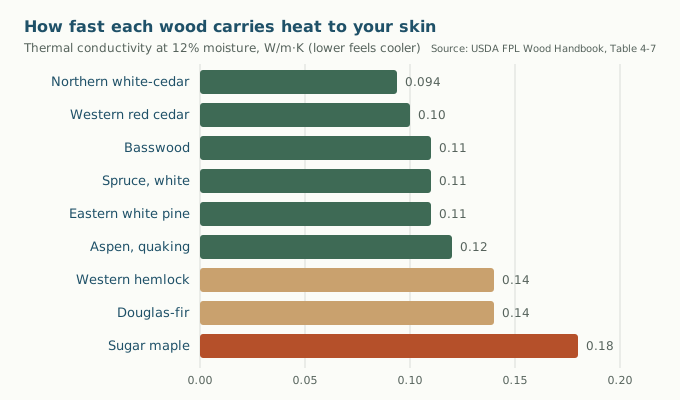
The figures below come from the Wood Handbook's thermal conductivity table (Table 4-7), which lists an approximate specific gravity and conductivity for each species. The Handbook warns that the numbers can be off by as much as 20 percent and aren't species averages, so treat them as a ranking rather than exact values. Red alder isn't in that table; its specific gravity is from Oregon State University's wood properties table, which is based on the same Handbook.
| Species | Specific gravity | Conductivity at 12% MC (W/m·K) | Resin and knots | Aroma | Typical sauna use |
|---|---|---|---|---|---|
| Western red cedar | 0.33 | 0.10 | Low resin; clear grades available | Strong, spicy | Walls, ceilings, benches, barrel staves |
| Northern white-cedar | 0.31 | 0.094 | Knotty in most grades | Cedar scent, milder | Walls, rustic cabins |
| Aspen (quaking) | 0.40 | 0.12 | Hardwood, no pitch | Neutral | Benches, backrests, walls |
| Basswood (linden) | 0.38 | 0.11 | Hardwood, no pitch, fine and even | None when dry | Benches, headrests, trim |
| Red alder | 0.41* | not listed | Hardwood, no pitch | Mild | Benches and panelling, also heat-treated |
| Spruce (white, Engelmann) | 0.37 | 0.11 | Knots and resin pockets | Light, resinous when new | Walls, ceilings, framing; clear stock for benches |
| Eastern white pine | 0.37 | 0.11 | Knotty grades bleed pitch | Piney | Walls, ceilings |
| Western hemlock | 0.48 | 0.14 | Low resin, usually few knots | Mild | Walls, ceilings, sometimes benches |
| Douglas-fir (for comparison) | 0.51 | 0.14 | Resinous | Resinous | Framing, not interior surfaces |
| Sugar maple (for comparison) | 0.66 | 0.18 | Hardwood | Neutral | Too dense for benches |
*Specific gravity at 12 percent moisture, from Oregon State University's table.
Cedar sauna wood
Western red cedar is the default in North America for good reasons. It is the lightest of the common commercial species, it has the lowest conductivity in the table above apart from northern white-cedar, and it moves less than the other species in Oregon State's table. It's a common choice in barrel kits and cabin saunas for walls and benches. The two downsides are the strong smell, which some people love and some don't, and the dust issue above. Pick clear or "select tight knot" grades for benches; knotty cedar is fine on walls. The barrel sauna guide covers cedar staves specifically.
Spruce and pine
Spruce is the traditional Finnish sauna wood. Sauna from Finland lists it for benches and structural parts and notes it is light and easy to get, and it's what most cabin saunas in Scandinavia are built from. For North American builders, spruce and pine panelling is cheap and widely stocked. Use it on walls and ceilings, choose clear boards or a hardwood for the benches, and expect some resin from knots in the first seasons.
Aspen, basswood and alder
These are the bench woods. All three are light hardwoods with no pitch, a fine texture that sands smooth, and little or no smell. Sauna from Finland names aspen as staying comfortable to sit or lie on at high temperatures and alder as staying cool to the touch and resisting moisture. Basswood, sold as linden or lime in European kits, is the softest and dents easily but has the lowest conductivity of the three hardwoods in the table. Sauna from Finland also singles out heat-treated alder for benches and panelling because it is durable, smooth and resin-free. Light-coloured benches show sweat marks, so bench towels and an occasional light sanding come with them.
Hemlock
Western hemlock is the budget alternative to cedar in many prefab saunas. It is denser, so benches feel slightly warmer, but it machines well, has little resin and a mild smell. A good choice for walls if cedar's scent is too much.
Thermally modified wood (thermo-wood)
Thermo-wood is ordinary spruce, pine, aspen or alder cooked at around 185 to 230°C in a controlled kiln. The International ThermoWood Association's handbook lists the changes: no resin, about half the equilibrium moisture content of untreated spruce at the highest treatment temperature, much less swelling and shrinkage, a darker through-colour, lower density and 20 to 25 percent lower thermal conductivity than untreated Nordic softwood. The handbook names saunas as an ideal use. The catch is strength: splitting strength drops by 30 to 40 percent and the association says it must not be used for load-bearing parts. Use it for panelling and bench slats, not for bench frames or posts.
Sauna bench wood
Benches take the most abuse and touch the most skin, so this is where to spend on wood. A good bench board is:
- low density (cedar, aspen, basswood, alder, or thermo-treated aspen or pine);
- clear and knot-free on every face that touches skin;
- narrow, with gaps between slats so the bench drains and dries;
- fastened from underneath so no screw head comes to the surface, or with screws countersunk well below it. The ThermoWood handbook calls for A2 (AISI 304) stainless fasteners in sauna walls, ceilings and benches.
The bench frame and supports can be spruce or another stronger species, since they're out of reach. The outdoor sauna build guide shows bench heights and layout, and the sauna temperature guide explains why the top bench sits so close to the ceiling.
Wood and finishes to keep out of the hot room
Pressure-treated wood
Pressure-treated lumber is made for decks, sill plates and ground contact. Its job is to resist rot and insects, which a properly ventilated sauna interior doesn't need. Consumer information for copper azole treated lumber notes that the preservative can rub off the surface onto skin, and advises gloves and washing after handling. Health Canada and the US EPA both warn never to burn treated wood, and the EPA says to wear a dust mask when sawing CCA-treated lumber. None of that fits a room where people sit bare-skinned on hot boards and sweat. Keep treated wood to the foundation and the parts of the frame the code requires, under the vapour barrier, and use untreated wood for everything inside.
Paint, varnish, lacquer and stains
Harvia's maintenance guidance is blunt: lacquer on the interior surfaces of a sauna is strictly prohibited. Its North American owner's manual adds that stains and sealers are not recommended because toxic vapours can appear when they heat up, and that protective agents have poor heat resistance and speed up darkening. Film finishes also trap moisture behind them, peel in the heat cycles and get hot and sticky on benches. Bare wood is the normal and safest finish for the hot room.
Sauna wood treatment: wax and paraffin oil
Treating sauna wood is optional. Harvia says wooden parts other than benches don't need to be treated, and if you do want protection, to use products made for saunas. For benches, it recommends paraffin oil, tested first on the underside of a board to see how much it darkens the colour. Sauna from Finland agrees that paraffin oil protects benches from moisture and makes cleaning easier. The ThermoWood handbook recommends mineral oil for interior walls, ceilings and benches in thermo-wood saunas.
Sauna waxes are the other option for walls and ceilings. Tikkurila's data sheet for Supi Sauna Wax lists benches, panelled walls, ceilings and door frames as uses, says it's ready for use after 24 hours, and tells you to pre-heat and ventilate the sauna thoroughly before the first session. Whatever you use, follow the product's own instructions for where it may go and how long it cures. Keep all treatments off the heater and its guard rails.
How to clean sauna wood
Most of the work is drying, not scrubbing. After each session, open the vent and leave the door ajar while the room is still warm; Harvia suggests running the heater about ten minutes with the vent open. Then:
- Sit on a towel. It keeps sweat off the benches, which is what turns light wood grey. Sauna from Finland calls the bench towel a must.
- Wipe benches with a damp cloth when needed.
- Deep clean one to three times a year in a family sauna, as Harvia recommends: a moderate amount of water and a slightly alkaline cleaner (pH 8 to 10), then rinse and dry with heat and ventilation.
- Lightly sand stained or rough benches with fine sandpaper. It takes off the grey layer and any raised grain.
- Check benches regularly for loose slats and raised nails or screws.
I'd skip the pressure washer and stick to Harvia's moderate amount of water; the wood only has to dry again afterward. The floor is a different job, covered in the sauna floor guide.
Questions people ask
What is the best wood for a sauna?
A light, low-resin species: western red cedar, aspen, basswood, alder, or thermally modified spruce or pine. Use clear, knot-free boards for benches; knotty spruce or pine is fine on walls.
Why are saunas made of wood?
Wood conducts heat very slowly, so it stays touchable at temperatures where metal, tile or glass would burn. The Wood Handbook puts softwood lumber at 0.10 to 0.14 W/m K, against about 45 for steel.
Is cedar or spruce better for a sauna?
Cedar is lighter, more stable and lower in resin, and it has a strong scent. Spruce is traditional in Finland and cheaper, but knots can bleed resin, so it suits walls better than benches.
Can I use pressure-treated wood in a sauna?
Not inside the hot room. Preservatives can transfer to skin, and treated wood is made for ground contact and exterior use. Keep it to the foundation and use untreated wood for walls and benches.
Should I seal or varnish sauna wood?
No. Harvia prohibits lacquer on interior sauna surfaces and advises against stains and sealers because they can give off fumes when heated. Bare wood, or sauna-specific wax or paraffin oil, is the norm.
How do you clean sauna wood?
Dry the room after every use, sit on a towel, and wipe benches with a damp cloth. A few times a year, wash with a mildly alkaline cleaner, rinse, dry with heat, and lightly sand stained spots.
What wood is best for sauna benches?
Aspen, basswood, alder, clear western red cedar, or thermally modified aspen or pine. They stay coolest to the touch and have no resin pockets.
Sources
- USDA Forest Products Laboratory, Wood Handbook, Chapter 4: Moisture relations and physical properties of wood (FPL-GTR-190)
- Oregon State University, Table of relative working and physical properties of wood
- Sauna from Finland, Popular wood materials for sauna construction
- Harvia, Maintaining your sauna (support article)
- International ThermoWood Association, ThermoWood Handbook
- Washington State Department of Labor and Industries, Asthma and western red cedar (via CDC Stacks)
Written by Leah, who has spent the better part of two decades heating, fixing and occasionally rebuilding a lakeside sauna and the cabin next to it.
Keep reading
Wood-fired sauna
How wood sauna stoves heat the room, stove types, chimney and clearance basics, firewood and CO safety.
Backyard sauna ideas
Placement, paths, porches, cooling spots, privacy and styles for a sauna in the backyard or at the cabin.
Sauna floor
Sauna flooring compared: concrete, tile, stone and duckboards, with drains, waterproofing and insulation.