Sauna and cold plunge: a cabin routine, what the research shows, and how to stay safe
Going from a hot sauna into a cold lake is old cabin tradition and a new wellness trend at the same time. Here is how people usually do it, what the evidence does and doesn't support, and where the real risks are.
Short answer
A sauna and cold plunge routine alternates 10 to 15 minutes of heat with a short cold dip (a lake, a tub, a cold shower or a roll in the snow), then a rest, usually for two or three rounds. Research shows the contrast is safe for most healthy adults and may ease muscle soreness after exercise and reduce stress for a few hours, but the evidence is small and short-term. Cold water can trigger a gasp reflex and heart rhythm problems, so enter slowly, never plunge alone in open water, skip alcohol, and talk to your doctor first if you have a heart condition.
What a sauna and cold plunge actually is
The idea is simple: get properly warm in the sauna, then cool down fast in cold water, then rest and repeat. Physiotherapists call the general method contrast therapy or contrast bathing, though in clinics it usually means alternating warm and cold water tubs rather than a sauna and a lake. At a cabin it tends to be whatever cold is closest: the dock, an outdoor tub, a hose, or a snowbank.
None of this is new. Sauna from Finland notes that many Finns cool off between rounds in a lake, the sea or by rolling in the snow, and lists a cold shower, a plunge pool or simply sitting outside as equally valid. The 2018 Mayo Clinic Proceedings review by Laukkanen and colleagues calls brief sauna stays followed by rapid cooling in cold water or a shower a common practice, and says it is generally safe for healthy people while warning that it can cause adverse reactions.
A typical sauna cold plunge routine
There's no official protocol. What follows is the pattern heater manufacturers and most sauna clubs describe, adjusted for a cabin with a lake or a tub.
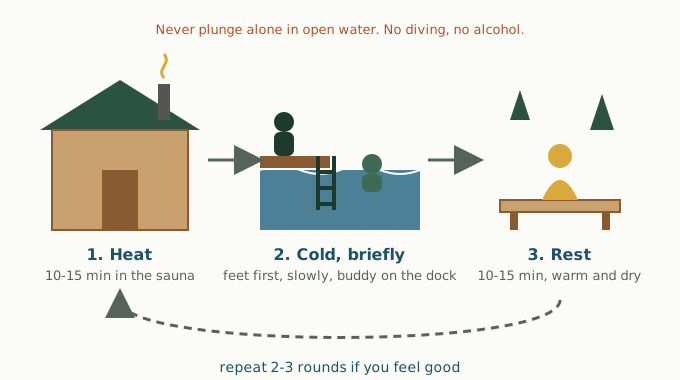
- Heat. Sit 10 to 15 minutes in the sauna, or until you're properly warm and sweating. Amerec's heater manual uses 10 to 15 minutes followed by an equal rest as its default (see the Amerec Designer manual).
- Walk, don't run, to the water. Wet docks and icy paths cause more injuries than the cold does.
- Get in slowly. Use a ladder or steps, feet first, and keep your head above water until your breathing settles. Diving in is the single habit every safety source warns against.
- Keep the dip short. Safety researchers suggest staying under 10 minutes in colder water, and after a sauna most people get out long before that. You don't need to tough it out.
- Rest. Sit outside or in the change room for 10 to 15 minutes, wrapped up, and let your breathing and heart rate come back to normal. Drink some water.
- Repeat two or three times if you feel good. Many people end on the cold, others end with a last warm round. Both are fine; just don't go straight from a long cold dip to the top bench.
| Step | Typical time | Cabin options |
|---|---|---|
| Sauna round | 10-15 min | Upper bench for more heat, lower bench to ease in |
| Cold | Short, well under 10 min | Lake off the dock, outdoor tub, cold shower or bucket, snow roll |
| Rest | 10-15 min | Porch bench, change room, wrapped in a towel or robe |
| Rounds | 2-3 | Stop early if you feel dizzy, numb or shaky |
Heat comes first for a reason. Getting warm through gives you a buffer, so the cold feels like relief rather than an attack. If your sauna runs hot, the guide to sauna temperature covers sensible ranges and why a milder room is often the better partner for cold water.
Lake dip, snow roll or outdoor tub
Each kind of cold behaves differently, and the safety points change with it.
| Lake or river | Snow roll | Outdoor tub or barrel | Cold shower or bucket | |
|---|---|---|---|---|
| How cold | Changes through the year; near freezing under ice | Intense on the skin, but brief | Whatever you fill it with; ice can be added | Mildest, easy to control |
| Main risk | Cold shock in open water, drowning, ice | Slips, bare feet on ice | Slips getting in and out | Low |
| Good for | Experienced bathers with a buddy | A quick, fun cool-down | Year-round routine next to the sauna | Beginners and anyone unsure |
If you're planning an outdoor sauna and cold plunge from scratch, put the cold right next to the sauna door with a short, non-slip path between them, and light it for evening use. The layout ideas in backyard sauna ideas and the site notes in how to build an outdoor sauna both assume you'll be walking between them barefoot and wet.
Benefits of sauna and cold plunge: what research shows
This is where the internet gets well ahead of the science. Here's what has been studied, in plain terms.
Sauna on its own
The strongest data is for regular sauna bathing, not the cold part. A Finnish cohort of 2,315 middle-aged men followed for about 21 years, published in JAMA Internal Medicine (2015), found that men who used the sauna four to seven times a week had a lower risk of sudden cardiac death and death from all causes than men who went once a week. It is an observational study of men in one region, so it shows an association, not proof that the sauna caused the difference.
Cold water on its own
A 2025 systematic review and meta-analysis in PLOS One (Cain and colleagues) pooled 11 randomized trials of cold water immersion in 3,177 healthy adults. Water temperatures ranged from 7 to 15°C (45 to 59°F). They found:
- lower self-reported stress 12 hours after immersion, but no clear change at other time points;
- a short rise in inflammation markers right after and one hour after the dip;
- no significant effect on immune markers in the pooled data, although one large trial of cold showers reported about 29% fewer sickness absences from work;
- some improvement in sleep and quality of life, each based on a single study.
The authors are frank about the limits: few trials, small samples, mostly men, mostly single sessions, and one huge shower study that dominates the numbers.
Hot and cold together
Studies that combine heat and cold are the thinnest of all. The best known is a 2013 meta-analysis in PLOS One by Bieuzen and colleagues on contrast water therapy after exercise. Across 18 trials, alternating warm and cold water reduced muscle soreness and strength loss compared with simply resting, but it worked about as well as cold water alone or other recovery methods, and every trial had a high risk of bias. A small 2021 study from the University of Copenhagen of eight winter swimmers who combined sauna and cold dips found they handled cold better than non-swimmers, but with so few people, all men, it can't tell you whether the habit causes anything.
The fair summary: sauna and cold plunge feels good to a lot of people, may help sore muscles and short-term stress, and sits on top of decent evidence for regular sauna use. Claims about fat loss, immunity or longevity from the combination itself aren't supported yet.
Sauna vs cold plunge
People sometimes ask which one to pick. They do opposite things in the short term. Sauna raises skin and core temperature, heart rate (to 120 to 150 beats per minute in the Mayo Clinic Proceedings review) and opens up blood vessels in the skin. Cold water clamps those vessels shut and triggers a burst of breathing and heart rate. The long-term evidence is much stronger for the sauna. The cold is the riskier half, which is why the rest of this guide is mostly about doing it safely.
Risks you should take seriously
Cold shock
Sudden immersion in cold water sets off an involuntary gasp and rapid breathing. The US National Weather Service says this phase can last the first two to three minutes and can be triggered by water as warm as 25°C (77°F). If your head is under when you gasp, you inhale water. Professor Mike Tipton's group, writing in the British Journal of Sports Medicine (2022), notes that cold shock peaks in water between 10 and 15°C, which is exactly the range most cold plunges use.
Their advice for anyone doing cold water therapy:
- enter gradually, never jump or dive in;
- let the gasping settle before putting your face in, and avoid long breath holds;
- keep immersions under 10 minutes in colder water, and don't judge your time by how cold you feel;
- have a trained observer, or at least another adult, watching.
Your heart
The cold shock response and the diving reflex pull your heart in opposite directions, and Tipton's group notes that heart rhythm problems are particularly common when the face goes under or you hold your breath. They list heart disease, structural heart problems, known rhythm disorders, high blood pressure, Raynaud's phenomenon and some medications as reasons for individual medical advice before cold water therapy. The Mayo Clinic Proceedings review says rapid cold after sauna is usually not recommended for people with heart disease, and records deaths from people diving head first into cold water right after a sauna.
Alcohol
Both reviews single out alcohol. In the sauna it raises the risk of low blood pressure, rhythm problems, falls and burns. In cold water, Tipton's group links alcohol and recreational drugs to fatalities. Have the drink after the last round, once you're warm and dry.
Open water and ice safety at the cabin
Never plunge alone in open water. That goes double after dark, in spring, and anywhere you can't stand up. The Alberta and Northwest Territories branch of the Lifesaving Society says plainly: never go onto ice alone, always go with a buddy.
For a winter dip through a hole in the ice, the ice has to hold the people standing around it. The Canadian Red Cross gives these minimums for clear, solid ice:
| Activity | Minimum clear ice thickness |
|---|---|
| Walking or skating alone | 15 cm (about 6 in) |
| Skating parties or games | 20 cm (about 8 in) |
| Snowmobiles | 25 cm (about 10 in) |
- Colour matters. The BC and Yukon branch of the Lifesaving Society says clear blue ice is strongest, white opaque or snow ice is about half as strong, and grey ice is unsafe.
- Measure in several places, and stop using the ice once spring thaw starts. Spring ice is rotten ice.
- Keep a throw rope, a ladder or a fixed step at the hole, and ice picks within reach.
- Mark the hole clearly when you're done so nobody walks into it after it skins over.
Rules for ice use vary by province, state and municipality, so check local guidance and stick to designated or tested ice where it exists.
Practical tips for a first try
- Start with a cold shower or a bucket at the end of your second sauna round, before trying a lake or tub.
- Keep warm clothes, a towel and footwear right by the water.
- Agree on a signal with your buddy and stay within reach of each other.
- Warm up gently afterward. The National Weather Service notes your core temperature can keep dropping after you leave cold water, so dress, sit, and have something warm to drink rather than rushing straight back to the hottest bench.
- Stop if you feel chest pain, confusion, numbness that doesn't fade, or can't stop shivering, and get help.
Questions people ask
Is it good to cold plunge after a sauna?
For most healthy adults it is a long tradition and generally safe if you enter slowly and keep it short. Research suggests it may ease muscle soreness and short-term stress, but the evidence is small. People with heart conditions should ask a doctor first.
How long should you stay in a cold plunge after a sauna?
Keep it short. Safety researchers writing in the British Journal of Sports Medicine advise keeping immersions under 10 minutes in colder water and not judging your time by how cold you feel. After a sauna, most people get out well before that.
Should you do sauna or cold plunge first?
Most routines start with the sauna so you go into the cold already warm, then rest and repeat for two or three rounds. Whether you finish on hot or cold is personal preference.
What temperature is a cold plunge?
Studies in a 2025 PLOS One review used water between 7 and 15°C (45 to 59°F). Cold shock can be triggered by much warmer water, and it peaks between about 10 and 15°C, so even a mild-seeming tub deserves a slow entry.
Who should not do a sauna and cold plunge?
People with heart disease, rhythm problems, uncontrolled high blood pressure, Raynaud's phenomenon or a history of fainting, anyone who has been drinking, and pregnant women should talk to a doctor first or skip it.
How thick should ice be for a winter dip?
The Canadian Red Cross says at least 15 cm (about 6 in) of clear, solid ice for walking alone and 20 cm (about 8 in) for groups. White or snow ice is about half as strong, grey ice is unsafe, and you should never go onto the ice alone.
Sources
- Laukkanen JA, Laukkanen T, Kunutsor SK. Cardiovascular and other health benefits of sauna bathing: a review of the evidence. Mayo Clinic Proceedings, 2018
- Cain T, et al. Effects of cold-water immersion on health and wellbeing: a systematic review and meta-analysis. PLOS One, 2025
- Tipton M, Massey H, Mayhew A, Morgan P. Cold water therapies: minimising risks. British Journal of Sports Medicine, 2022
- Bieuzen F, et al. Contrast water therapy and exercise induced muscle damage: a systematic review and meta-analysis. PLOS One, 2013
- National Weather Service, Cold water hazards and safety
- Canadian Red Cross, What you need to know if you fall through the ice
Written by Leah, who has spent the better part of two decades heating, fixing and occasionally rebuilding a lakeside sauna and the cabin next to it.
Keep reading
Wood-fired sauna
How wood sauna stoves heat the room, stove types, chimney and clearance basics, firewood and CO safety.
Backyard sauna ideas
Placement, paths, porches, cooling spots, privacy and styles for a sauna in the backyard or at the cabin.
Sauna floor
Sauna flooring compared: concrete, tile, stone and duckboards, with drains, waterproofing and insulation.