Wood stove for a small cabin: sizing, clearances, chimney and safe installation
A small cabin is the easiest place to get wood heat wrong, because almost any stove is big enough. Here is how to size one for the space, what the codes ask for around it, and what makes it burn clean.
Short answer
For a small cabin, pick the smallest certified stove that covers your coldest use: Natural Resources Canada warns that an oversized stove gets turned down low most of the time and makes smoky, polluting fires. Choose a model certified to the US EPA 2020 limit or CSA B415.1, install it to the clearances in its own manual (CSA B365 in Canada, NFPA 211 in the US) on a non-combustible floor pad, and vent it through a listed 650°C chimney (ULC-S629 or UL 103HT). Then have it inspected (in Canada, by a WETT-certified pro), burn wood under 20% moisture, and fit smoke and CO alarms.
Why size matters more in a small cabin
In a full-size house the usual worry is a stove that can't keep up. In a cabin of a few hundred square feet it runs the other way. Natural Resources Canada's A Guide to Residential Wood Heating says it plainly: a stove that is too large "will overheat the space and be turned down too low much of the time, producing smoky, polluting fires." The same guide notes that even a small stove can make a confined space uncomfortably warm.
That turned-down fire is the real problem. With the air shut back to stop the cabin from cooking, the wood smoulders instead of burning. You get more smoke out the chimney, more creosote inside it, and a stove that never reaches the temperature it was designed to run at. The US EPA's Burn Wise program makes the same point from the other side: for most appliances, a smouldering fire is neither safe nor efficient.
So the goal for a small cabin wood stove is a firebox you can run hot, with the air open the way the manual intends, without driving everyone outside. NRCan's advice is to judge heating capacity by the size of the firebox rather than the overall size of the stove, since the outer shell can be misleading.
Matching the stove to the cabin
EPA groups wood stoves into three rough sizes. Small stoves suit a family room or a seasonal cottage. Medium stoves suit small houses, energy-efficient homes of medium size, and cottages used in winter. Large stoves are for open-plan or older, leakier houses in cold climate zones. Most cabins land in the first two groups, and very few need the third.
| Cabin situation | Stove size to look at | What to watch |
|---|---|---|
| Tiny cabin or bunkie, used spring to fall | Small (mini) stove | Even a small firebox can overheat a single room; check the manual for minimum room size and clearances, which matter more in tight floor plans |
| Small cabin, weekends year-round, insulated | Small to medium | Size for the coldest weekend you will actually use it, not the coldest night on record |
| Small cabin lived in through winter, insulated | Medium | Burn time on one load matters for overnight heat; a larger firebox run hot beats a big stove run on low |
| Older, leaky or uninsulated cabin | Small to medium, after air-sealing | Fix drafts and insulation first; a bigger stove in a leaky shell mostly heats the outdoors |
| Wood cook stove as the main heater | Depends on the model's firebox | Treat it like any other stove for clearances, chimney and inspection; read its own listing and manual |
If you are still planning the building, it is worth settling the stove location early, because the chimney route, the floor pad and the clearances all shape the layout. The guide to building a small cabin covers the shell itself; a bunkie is the extreme case of a tiny space where oversizing is almost guaranteed.
EPA also recommends talking to an experienced hearth retailer and bringing a floor plan. That is good advice for a cabin, where ceiling height, an open loft and where people sleep all change what "warm" means.
Certified stoves: EPA 2020 and CSA B415.1
A certified stove burns cleaner and, just as relevant for a cabin owner, is what installers, building officials and insurers expect to see. In the US, EPA's Step 2 limit took effect on May 15, 2020, and lowered the allowed particulate emissions to 2.0 grams per hour (2.5 g/h for stoves tested with cord wood). For comparison, EPA puts older uncertified stoves at 15 to 30 grams of smoke per hour.
Canada's equivalent emissions standard is CSA B415.1. Many municipalities now allow only certified appliances to be installed; the City of Kelowna, for example, permits only solid-fuel appliances that meet either the CSA or the EPA test standard. Check your own municipality before you buy, especially for a used stove.
NRCan's guide also notes that many insurance companies will not cover houses with uncertified stoves. If you are inheriting an old box stove with the cabin, that is the first thing to check.
Clearances and floor protection
A wood stove heats the walls, floor and ceiling around it by radiation, which is why the distance to anything that can burn is set by testing and by code rather than by feel.
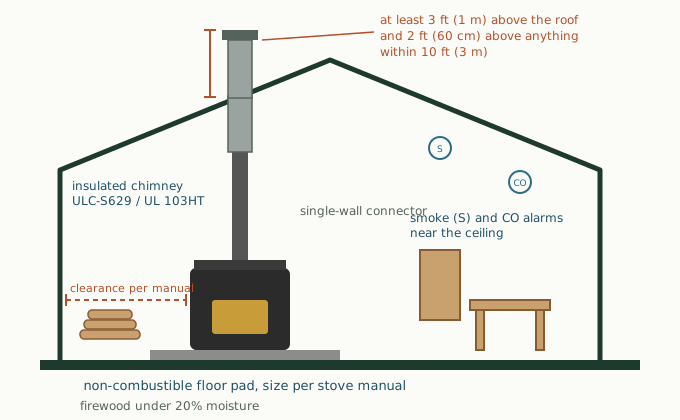
- Certified, listed stoves: use the clearances on the stove's label and in its installation manual. These come from testing that model and are usually much smaller than the generic figures.
- Canada: the installation code is CSA B365. The Yukon Housing Corporation's summary of it points out that when the manufacturer's certified instructions differ from the code, the manufacturer's instructions take precedence. B365 also sets the rules for reducing clearances with approved shields.
- United States: NFPA 211 is the standard most codes refer to. Extension guides based on it give 36 in (about 900 mm) from an unlisted radiant stove to unprotected combustibles; NRCan gives 1200 mm (48 in) for an uncertified radiant stove. Either way, an unlisted stove eats a lot of floor space in a small cabin.
- Floor pad: NRCan specifies a continuous, non-combustible surface under the stove. Its size, and how far it extends in front of the loading door and to the sides, comes from the manual. For unlisted stoves, older US guidance based on NFPA 211 called for protection extending 18 in (457 mm) beyond the appliance on all sides.
- Stovepipe: the single-wall connector between the stove and the chimney has its own clearance. Older NFPA-based guidance uses three times the pipe diameter to unprotected combustibles; a listed stove's manual will give its exact figure.
The chimney
Most cabin stoves vent through a factory-built metal chimney. NRCan's guide says wood stoves must use the 650°C (1,200°F) chimney. In Canada that chimney is tested to CAN/ULC-S629; in the US the matching listing is UL 103HT. Many chimney systems carry both. Two practical rules apply to almost every cabin:
- Height. Building codes require the top of the chimney to be at least 1 m (3 ft) above where it leaves the roof, and at least 60 cm (2 ft) higher than any roof, wall or obstacle within 3 m (10 ft) horizontally. NRCan warns that cottages with shallow-pitch roofs often end up with short systems that draw poorly, so don't skimp on the last section.
- Clearance to framing. The insulated chimney still needs an air space to combustibles where it passes through the ceiling and roof. One common listed chimney specifies 2 in (50 mm); use the figure for the system you buy, along with its own ceiling support, firestop and attic shield.
Run the chimney up through the warm inside of the cabin where you can. A chimney that stays warm drafts better and collects less creosote, which brings the cleaning schedule into it. The article on how often to clean a chimney goes through inspection intervals and what deposits to look for.
Outside combustion air
This is where advice conflicts, so it is worth knowing both sides. Some codes and some stove listings call for an outdoor air supply, and some stoves are approved for a direct connection. NRCan's guide, on the other hand, says research shows outdoor air supplies don't improve performance, and that reverse flow can be hazardous when a duct connects straight into the firebox. In a very small, tight cabin the stove still needs air from somewhere, so the practical answer is this: follow the stove's manual and your local building code, and if an outdoor air kit is optional, ask your installer or inspector whether it makes sense for your building.
What doesn't change is that the fire needs air and the chimney needs draft. NRCan links low flue temperatures and weak draft to smoke spilling into the room, which is one more reason the alarms below are not optional.
Installation, WETT inspection and insurance
Errors in a do-it-yourself installation are often not visible, as EPA puts it, which is why a second set of eyes matters.
- Permits. Many municipalities treat a new wood stove as a building permit item. NRCan recommends having the installation inspected by your municipal building department.
- WETT in Canada. Wood Energy Technology Transfer (WETT) is a non-profit training and education association whose certified installers, inspectors and sweeps follow a code of ethics. Insurers often require a WETT-certified inspection before they will cover a wood-burning appliance, and an undisclosed stove can lead to a claim being denied. NRCan suggests looking for the WETT logo when you hire.
- United States. EPA points to credentials from the Chimney Safety Institute of America (CSIA) and the National Fireplace Institute (NFI) as a way to find competent installers and inspectors.
- Tell your insurer. For a seasonal cabin this is easy to forget, and it is the part most likely to cost you later.
Firewood under 20% moisture
A certified stove only burns clean on dry wood. EPA and NRCan agree on the number: wood burns best below 20% moisture. Freshly cut wood holds 35 to 50% water by weight, according to NRCan, and drying it takes time:
- Season wood for at least six months (EPA); NRCan says a full year or more is common, with finely split softwood drying in one summer and large hardwood pieces taking up to two.
- Stack it outdoors, off the ground, with only the top covered so the sides can breathe.
- Split it small. For high-efficiency stoves, NRCan suggests the largest pieces be no more than about 150 mm (6 in) across. Cabin stoves have small fireboxes, so this matters even more.
- Check it with a moisture meter on a freshly split face, not the weathered outside of the log.
Wet wood is the most common reason a small stove smokes, won't get hot and coats the chimney. If the cabin also has a wood-fired sauna, the same woodpile rules apply to the sauna stove.
Smoke and CO alarms
NRCan recommends at least one smoke alarm on or near the ceiling at the exit of the room with the stove, and at least one carbon monoxide alarm at or near ceiling level. Provincial and state rules may go further. Ontario, for instance, requires a CO alarm next to each sleeping area in any home with a fuel-burning appliance, and on every storey from January 1, 2026.
NRCan also notes that ashes can hold live embers for days and give off carbon monoxide, so carry them out in a metal container with a lid and leave it outside, away from the cabin and the woodpile.
Living with a cabin wood stove
A few habits keep a small stove working well year after year:
- Light small, hot fires and add wood in smaller loads rather than packing the firebox and shutting the air down.
- Check the chimney regularly in the first season until you know how fast deposits build up, then settle on a schedule.
- Before the first fire of the season, look for nests, a damaged cap or loose pipe joints, especially after the cabin has sat closed.
- At the end of the season, clean out the ashes and close up the stove properly; the guide to winterizing a cabin covers the rest of the shutdown.
Local codes vary, and stove manuals are specific to each model, so treat this as a map of what to check rather than a substitute for either.
Questions people ask
What size wood stove do I need for a small cabin?
Usually a small one. EPA describes small stoves as suited to a family room or a seasonal cottage, and medium stoves to small houses and cottages used in winter. NRCan warns that an oversized stove runs turned down and smoky, so pick the smallest certified model that covers your coldest real use, and compare firebox size rather than the size of the stove body.
Can a wood stove be too big for a cabin?
Yes. A stove that is too big overheats the space, so people shut the air down, the fire smoulders, and you get more smoke and more creosote in the chimney. A smaller stove run hot is cleaner and safer.
How far does a wood stove need to be from the wall?
For a certified stove, the clearances on its label and in its manual apply, and they are often much smaller than the generic figures. For uncertified radiant stoves, NRCan gives 1200 mm (48 in) and older NFPA 211 based guidance gives 36 in to unprotected combustibles. Approved heat shields can reduce clearances under CSA B365 or NFPA 211.
What chimney do I need for a cabin wood stove?
A factory-built 650 C (1,200 F) chimney listed to ULC-S629 in Canada or UL 103HT in the US, installed with its own supports and firestops. The top should be at least 3 ft (1 m) above the roof and 2 ft (60 cm) above anything within 10 ft (3 m).
Do I need a WETT inspection for a cabin wood stove?
It is not a legal requirement everywhere in Canada, but many insurers require a WETT-certified inspection before they will cover a wood-burning appliance, including at a cottage. Many municipalities also require a building permit and inspection.
Does a wood stove need an outside air kit?
Only if the stove manual or your local code requires it. NRCan's guide says research shows outdoor air supplies don't improve performance and can backflow, but some codes and listings still call for them, so follow the manual and ask your inspector.
Sources
- Natural Resources Canada / CMHC, A Guide to Residential Wood Heating
- US EPA Burn Wise, Choosing the right wood-burning stove
- US EPA Burn Wise, Best wood-burning practices
- DuraVent, DuraTech chimney installation instructions (ULC-S629 / UL 103HT)
- Yukon Housing Corporation, Safe and efficient home heating (CSA B365 summary)
- Government of Ontario, Carbon monoxide safety
Written by Leah, who has spent the better part of two decades heating, fixing and occasionally rebuilding a lakeside sauna and the cabin next to it.
Keep reading
How to winterize a cabin
Closing a seasonal cabin for winter: water, well, toilets, stove, sauna and power, with a printable checklist.
How often to clean a chimney
Yearly inspection, the 1/8 inch cleaning mark, creosote stages, DIY sweeping, logs and chimney fires.
What is a bunkie
The cottage sleeping cabin explained: sizes, Ontario permit thresholds, heat, insulation and build steps.